April in the Garden
April is when we know that spring is finally here in Michigan. The warm days of spring are a welcome change, but cold, frosty nights are still with us and we may always get a late spring flurry or hard frost, particularly if you live more in northern Michigan. April frosts are almost inevitable in most of Michigan, so as eager as we are to get out in the garden, we have to have some patience and planning with what we put into the ground, set outside, or how changes and actions we take in the garden. But by the end of the month we can feel the hot days of summer just around the corner.
We just had the full moon yesterday on April 1st. One of the local indigenous tribes to this area, the Ashinaabe peoples, called this the showing bud full moon, as this is when the trees and shrubs are really starting to show their buds as spring unfolds here. This full moon period is one to enjoy all the new bud growth and spring ephemeral flowers. I hope everyone gets out often to see the changes that happen every day!
Design
- What summer and fall flowering perennials do you have that need dividing? What spring ephemerals do you have that need dividing after they flower or die back in late spring? Some like snowdrops, bluebells and siberian squill are best divided “int he green” (while still leafy) immediately after flowering. Other bulbs, like daffodils, crocuses, grape hyacinth and hyacinth do better in late spring (May/June) once foliage has turned yellow or brown. What about plants from your friends? Make lists and get inspired and play with the possibilities with your garden maps.
- Make regular trips to the garden center throughout the spring an summer, that way you become more familiar with the many plants available and when they are flowering or putting on their best decorative display.
- Visit local gardens such as Cooley Gardens or MSU’s landscape arboretum and horticultural demonstration gardens to get inspiration and see what is coming up now and can offer you early season interest in your garden next spring.
- Walk around your neighborhood and local parks frequently to catch the spring ephemerals as they bloom in quick succession. What combinations of color and texture, of scents, do you like?
- If you want a native plant garden, visit local conservation or nature centers for inspiration and look around areas that match your garden’s conditions more, like the meadows at Fenner Nature Center or Woldumar.
- Design Idea for smaller spaces: Think about next spring and creating a spring ephemeral lasagna planting to pack more blooms into smaller spaces.
- Design idea for continuous blooms: Think about topper plants you could plant above your spring ephemerals to create long-lasting displays this summer after your spring flowers and plants fade.
Inside
- Check your power tools and get them serviced if you didn’t do it over winter.
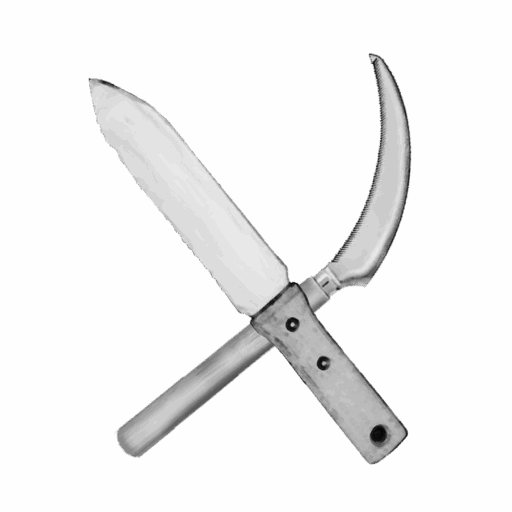
- Sharpen your hand tools that have blades if you didn’t in the fall, and check metal parts of tools for rust or other damage. How to deal with rust link.
- Store any plants you have purchased or started indoors in as bright a location as possible. Start hardening them off by placing them outdoors for a short period each day, avoid putting them out in windy conditions at first, and slowly build up their tolerance to wind and hotter and colder weather. Your plants are babies right now, so baby them accordingly.
- Repot houseplants if needed.
- Start warm season seeds indoors, such as nasturtium, cucumber, summer and winter squash, melons and watermelon.
Outside
- April is the month to do garden tidying, this is when real gardening work begins. It’s a month of raking, digging, pruning and planting.
- If you want to wait to begin spring garden cleanup until overnight temperatures are consistently above 50F in order to protect overwintering insects, some easy indicators you can look for are: when the dandelions are blooming, or you feel comfortable walking outside without heavy winter clothing at night. This may be mid-late April, or as late as early May. You can do some cleanup, but leave taller (8-24″) hollow stems for cavity-nesting insects and retain leaf litter in undisturbed zones to shelter fireflies, bumblebees, and overwintering moths.
- Prune back old growth from perennial herbaceous plants after you see new growth appearing.
- Rake up debris from lawns and beds.
- Plant dormant trees, shrubs, and vines once the soil can be worked. Prune all fruit and nut trees at planting time to remove any broken or weak (thin, short) shoots.
- Avoid working the soil if it is too wet or has not completely thawed. A handful of thawed soil should squeeze into a ball that holds its shape but breaks easily apart when pressed with a thumb or a finger.
- Sow cool season seeds that say “sow as soon as soil can be worked” or “after danger or hard frost has passed”. These seeds will take longer to germinate than those started indoors but will be stronger, so be patient and water often. Some plants you can direct sow as soon as the soil can be worked: Bachelor’s buttons, cabbage, calendula, california poppy, godentia, kale, love-in-a-mist, peas, phlox, poppy, rocket larkspur, spinach, sweet pea, swiss chard.
- Divide and replant spring ephemerals that are getting crowded after they have finished blooming. Some like snowdrops, bluebells and siberian squill are best divided “int he green” (while still leafy) immediately after flowering. Other bulbs, like daffodils, crocuses, tulips, grape hyacinth and hyacinth do better in late spring (May/June) once foliage has turned yellow or brown.
- Divide and replant perennials that bloom in mid-summer or later, such as asters, goldenrod, yarrow, daylilies, and sedums.
- Notice where water pools and sits, when conditions dry there improve soil drainage through the addition of organic matter.
- Warm up vegetable beds with row covers or greenhouse plastic to keep early plants and seeds happier.
- Check your trees for any deer damage and make some cages or wrap them accordingly to protect them from further damage. Never use pruning paint or paste. Trees have a natural ability to create a barrier between living and dead wood. Painting over a cut impairs this ability.
Pruning
Why prune?
We prune for the health and shape of the plant, to remove dead, damaged or diseased parts first, then we shape for light and air filtration, directing its shape to promote younger, healthier branches and increase yield of fruit. Pruning can encourage larger blooms or more frequent blooms, healthier growth, minimizing diseases or pests, or keeping the size compact tot fit the landscape.
Before you start pruning, properly identify the shrub/tree and take time to research its exact needs and timing for pruning care.
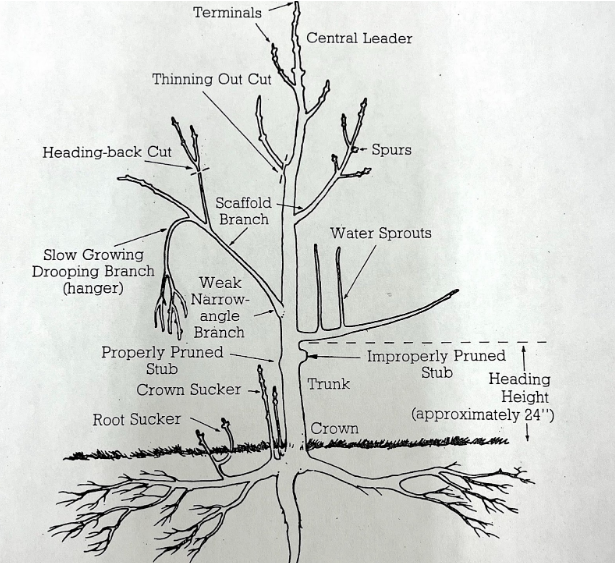
Pruning Tips:
- Use the right tool for the job! Hand pruners for growth up to ¾” in diameter, long-handled lopers for growth up to 1 ½” and pruning saws for growth up to 6” in diameter.
- Always use clean and sharp tools to avoid stressing the plant.
- Sterilize tools between trees, ideally between cuts, to prevent spreading disease, especially if you are pruning diseased or pest-infested branches.
- Always use pruners or loppers with the blade side towards the plant and the hook towards the part to be removed.
- Prune no more than 25% of the trees mass per year, “less is more”!
- To reduce the height of a tree that’s too tall, cut limbs at the top of the tree to a lateral branch that is the height you desire. Head that shoot and remove all upright shoots that might compete.
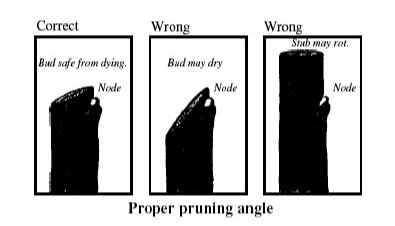
- Cut just above the bud, leaving only ¼ inch, otherwise a dead stub will develop that may allow entrance of disease and the bud will dry out and die. You want the smallest cut possible, and at an angle so water wont sit there, but rather run off. If it sits there it can lead to the stub rotting. Where you are removing larger branches, remove them just above the wrinkled shoulder where it attaches to another branch. Use a jump cut to remove them safely so they don’t tear the wood, which can lead to infection.
- Don’t leave stubs, always cut back to a join, whether your are cutting off a large branch or deadheading a flower. Branches should be removed to the branch collar, and smaller growth should be cut back to a bud or branch union. There is not absolute set angle for pruning, each plant should be pruning according to its needs, but 45 degree is generally a good angle, and with the cut sloping away from the nearest bud, so that water doesn’t run into the bud and cause rot.
- Never use pruning paint or paste. Trees have a natural ability to create a barrier between living and dead wood. Painting over a cut impairs this ability.
Cutting Order of Operations:
- 1st-cut branches that are broken, dead or diseased
- 2nd-cut branches that grow straight down, straight up, or directly into another branch.
- 3rd-remove suckers around the bottom of the trunk. Remove lateral branches that are too low (under 3’ unless a very young tree)
- 4th-look at and choose the structure or scaffolding branches, usually 3-4 evenly distributed around the trunk starting at 3-4’ height, ideally we would be able to fit a person or an orchard ladder between them.
When we cut a tree or shrub, if we want to be very intentional, we can ask ourselves:
- Why this cut? Name it–this is a broken branch.
- How will growth proceed from it? Imagine and describe it.
- Will this allow for more sun exposure and air flow? Where is south and west, how do you imagine the sun coming in differently with this cut?